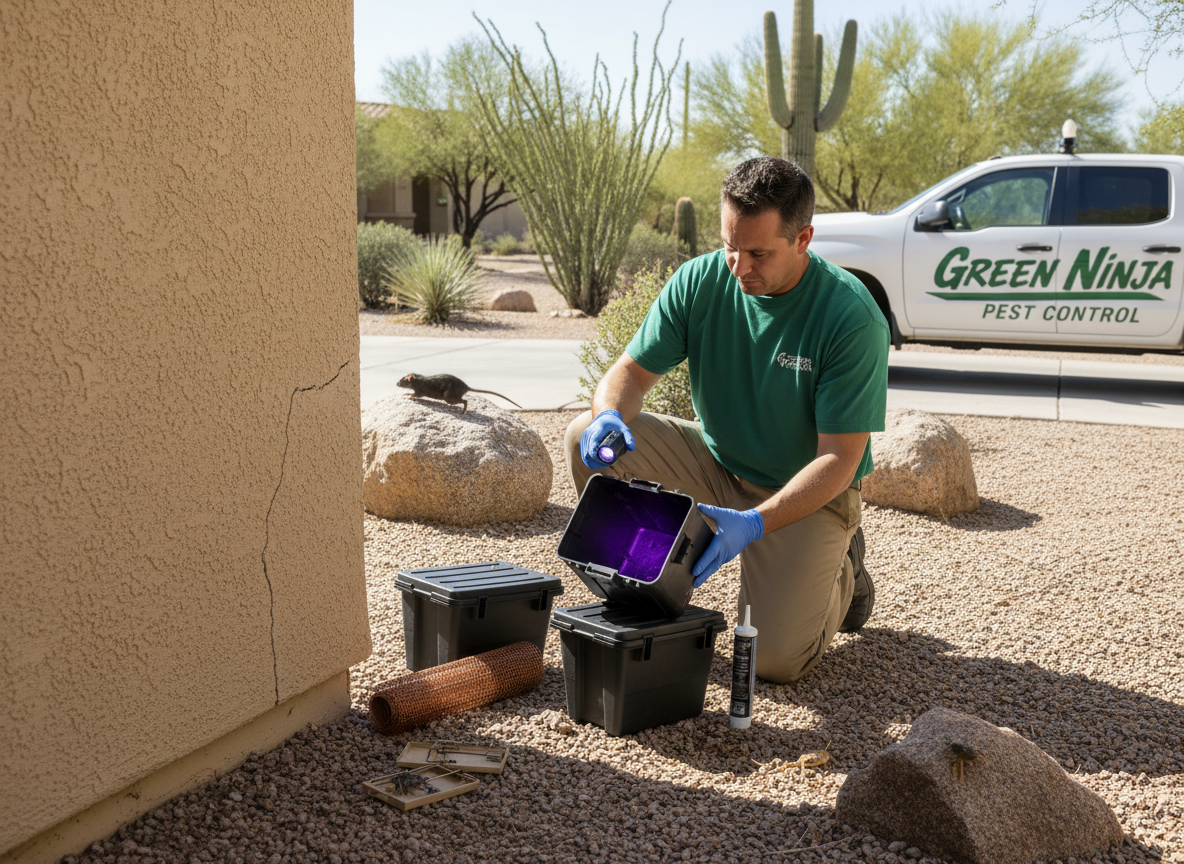
Rodent control starts with figuring out which rodent it is, because the three common Arizona rodents live in different places and need different work. Roof rats are climbers that travel citrus branches, oleander hedges, palm fronds and overhead utility lines and enter at the roof line, through unscreened attic vents, gaps at the tile eave, and where the AC line set enters the wall. Pack rats build stick nests in cactus, wood piles, engine bays and sheds and chew vehicle wiring. House mice and deer mice come in at ground level through gaps under garage doors and around plumbing. The inspection covers the attic for droppings, runways and gnawed wiring, the roof line for entry gaps, the yard for nests, and the garage.
Roof rats spread across the Phoenix metro from the original Arcadia infestation and are now common in any neighborhood with mature citrus, oleander, palms and flood irrigation: central Phoenix, older Mesa, Tempe, Chandler, Glendale and Scottsdale. They eat the citrus from the inside, leaving hollowed fruit on the tree, and nest in attics and palm skirts. Pack rats dominate on desert edge lots in north Scottsdale, Fountain Hills, Apache Junction, Tucson, Marana and Oro Valley, and their nests carry kissing bugs. In Flagstaff, Prescott and Prescott Valley the concern is deer mice, which carry hantavirus, moving into cabins, garages and sheds in fall, plus pack rats in the pinyon juniper. Lake Havasu City and Bullhead City add boat and RV storage full of nesting material. Fall is the peak season statewide as nights cool.
Rodent work is done under an Arizona Department of Agriculture Pest Management Division license, and any rodenticide goes only inside tamper resistant bait stations placed where children, dogs and wildlife cannot reach the bait, according to the label. Snap traps are the first choice inside attics and garages because a trapped rat can be removed, while a poisoned rat dies in a wall void and the smell lasts for weeks. Bait stations are used along block walls and in commercial settings. Deer mouse cleanups in the high country follow hantavirus precautions: no dry sweeping, disinfectant applied to droppings before removal, gloves and respirator. Exclusion uses hardware cloth, copper mesh, sealant and vent screens, and the trapping runs before the sealing so nothing is sealed inside.
The mistakes are consistent. Poison alone with no trapping and no exclusion leaves dead rats in the walls and a new family moving in through the same gap. Sealing the roof line without trapping first traps rats in the attic. Trimming citrus and oleander back off the roof and walls is the single biggest change a homeowner can make and is usually the reason a treatment either holds or fails. Palm trees with unpruned skirts are roof rat apartments. Pack rat nests that are removed without treating for kissing bugs release the bugs into the house. A cat or a dog in the home rules out some products and moves the plan toward traps and exclusion. Vehicles parked outside on desert edge lots need engine bay checks, because pack rat wiring damage costs more than any pest control program.
Technician insight
Roof rats almost never come in at ground level. When a homeowner has already put out bait blocks on the patio and still hears scratching in the ceiling at night, the entry is nearly always the gap where the tile roof meets the fascia or an attic vent with a screen that rusted out years ago. Look up first.
Scratching in the Ceiling of a Citrus Neighborhood Home
A 1970s home on a flood irrigated lot with 4 mature citrus trees and an oleander hedge against the back wall, with noise in the ceiling at night and hollowed oranges on the tree. The attic had droppings and a runway along the plumbing vent. Snap traps caught the rats over 2 weeks, the attic vents got hardware cloth, the tile eave gap was sealed, the line set entry was packed with copper mesh, and the homeowner cut the oleander back 3 feet from the wall. No activity at the follow up.
Rodent Control Services We Offer
✓Roof Rat Control
Attic trapping, roof line and vent sealing, and treatment of citrus, oleander and palm harborage for roof rats in Phoenix metro and Tucson neighborhoods.
✓Pack Rat Removal
Nest location and removal, trapping, kissing bug treatment of the nest site, and exclusion of sheds, engine bays and wood piles on desert edge properties.
✓Mouse Control
Trapping and ground level exclusion for house mice and deer mice, with hantavirus safe cleanup for deer mouse infestations in the high country.
✓Attic Inspection and Trapping
Inspection of the attic for droppings, runways, nests and chewed wiring, followed by a snap trap program checked on a schedule until activity stops.
✓Rodent Exclusion and Entry Sealing
Hardware cloth over attic vents, sealing at the tile eave, AC line set and plumbing penetrations, and door sweeps on garage doors.
✓Tamper Resistant Bait Station Service
Locked bait stations along block walls and commercial perimeters, placed and checked according to the label so bait is never accessible to pets, kids or wildlife.
✓Rodent Cleanup and Sanitation
Removal of droppings, nesting material and dead rodents with disinfectant, including hantavirus precautions where deer mice are involved.
How it works
- 1
Identify the Rodent and the Entry
The technician checks the attic, roof line, garage, yard and vehicles, identifies roof rats, pack rats or mice from droppings and sign, and maps every entry gap.
- 2
Trapping Program
Snap traps go in the attic, garage and along runways, and tamper resistant bait stations along exterior walls where appropriate. Traps are checked and reset on a schedule until activity stops, usually 1 to 3 weeks.
- 3
Exclusion
Once trapping shows the population is gone, every entry point is sealed with hardware cloth, copper mesh, sealant and vent screens, and harborage such as palm skirts and wood piles is addressed with you.
- 4
Cleanup and Follow Up
Droppings and nests are removed with disinfectant, and a follow up visit confirms there is no new activity at the sealed points.
Pricing
The price depends on how many entry points need sealing, the size and access of the attic, how long the trapping program runs, whether a pack rat nest and kissing bug treatment are involved, and whether hantavirus cleanup is needed. A single story home with 2 open attic vents and one line set gap is a small job. A two story home with a tile roof, 6 palms and a rat colony in the attic is not. You get the number after the inspection and before any work.