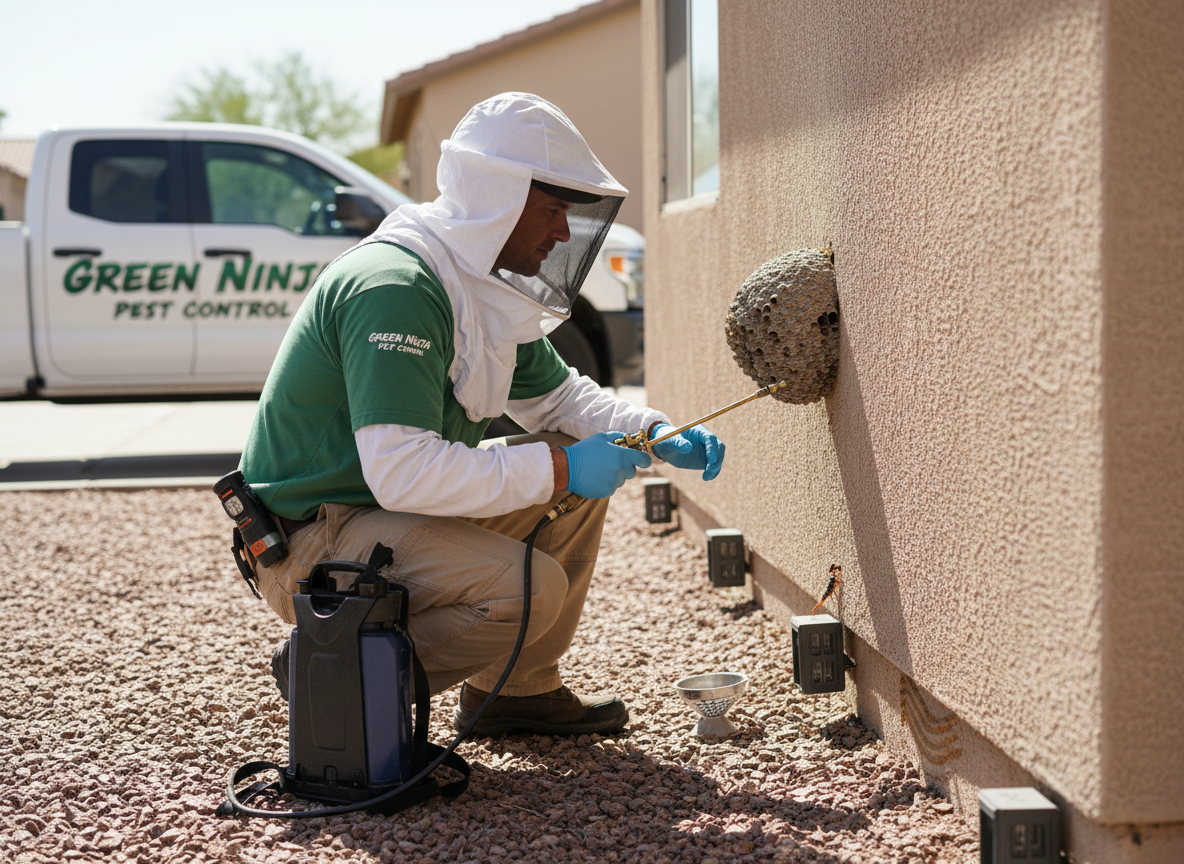
The first question on a bee call is whether it is a swarm or a hive. A swarm is a ball of bees hanging on a branch, a block wall, a mailbox or a patio beam, usually in spring and fall, and it is a colony in transit that may leave on its own within a day or two or may move into the nearest wall void. An established hive is bees going in and out of one spot, a weep hole, an irrigation valve box, a water meter box, a shed wall, a chimney or a hollow saguaro, and it has comb behind it. The technician watches the entry, listens to the wall, and checks for staining or dripping honey before deciding on treatment, removal or both. Wasp calls are mostly paper wasps under eaves and patio covers and yellowjackets in ground holes and block wall cavities.
Africanized honey bees are established across all of Arizona below about 5,000 feet, which covers the Phoenix metro, Tucson, Yuma, Lake Havasu City, Bullhead City, Casa Grande and Sierra Vista. They look like European honey bees and cannot be told apart by eye, they defend a hive far more aggressively and in far greater numbers, and they will pursue for hundreds of yards. Spring and fall swarm seasons bring the most calls, and summer heat sends bees to pool edges, drip emitters and AC condensate lines for water. In Tucson, Marana and Oro Valley hives in saguaro cavities and old adobe walls are common. Flagstaff and Prescott sit high enough that Africanized pressure drops off and the calls turn to yellowjackets, paper wasps and bald faced hornets in late summer.
Bee work is done under an Arizona Department of Agriculture Pest Management Division license by a technician in a bee suit with a veil, with the area cleared of people and pets first. Treating a hive in a wall means applying product at the entry and into the void, then opening the wall or the box and removing all of the comb, because comb left behind melts in summer heat, drips honey through drywall, attracts ants and roaches, and calls the next swarm in by scent. The opening is then sealed and the scent masked. A hanging swarm with no comb is sometimes treated, sometimes left to move on, depending on where it is and who is nearby. Wasp nests are treated at dusk when the wasps are on the nest, and yellowjacket ground nests are treated at the entrance and left alone for 24 hours before the hole is filled.
The edge cases are where people get hurt. A homeowner sprays a hive entrance with a hardware store can, the colony pours out, and the neighbor's dog or a child on a bike is chased. A hive in a wall is sealed shut without treatment and the bees chew through the drywall into the house. Comb is left in a wall after a treatment and 2 months later the ceiling stains and a new swarm arrives. A pool pump housing or an irrigation box with a hive inside gets opened for maintenance. Anyone stung many times, anyone with a known allergy, and anyone stung in the mouth or throat needs 911. Landscapers, roofers and pool techs working near a known hive should not start until it is gone.
Technician insight
The place a hive hides longest in an Arizona yard is the irrigation valve box in the front corner of the lot. The lid keeps it shaded, the drip line gives them water, nobody opens it for a year, and the first sign is the landscaper getting stung when he lifts the lid. Any box with bees coming and going from the notch in the lid has comb underneath.
Bees Going In and Out of a Weep Hole on a Second Story Wall
A two story stucco home with bees entering a single weep hole above the patio for several weeks and a faint honey stain starting on the interior wall. The technician treated the entry and void from a ladder in a bee suit, opened the stucco below the weep hole, removed roughly 2 feet of comb, closed and sealed the opening and masked the scent. A follow up 5 days later found no returning bees.
Bee and Wasp Removal Services We Offer
✓Africanized Bee Swarm Removal
Assessment and, where needed, treatment of a hanging swarm on a wall, tree, mailbox or patio beam before it moves into a structure.
✓Bee Hive Removal From Walls and Voids
Treatment and physical removal of an established hive inside a stucco wall, block wall, chimney or shed, with the void sealed afterward.
✓Honeycomb Removal
Opening the wall or box and removing all comb and honey after a hive treatment so it does not melt, stain, draw ants or attract the next swarm.
✓Irrigation Box and Meter Box Bee Removal
Removal of hives from irrigation valve boxes, water meter boxes, pool equipment housings and other ground level cavities.
✓Paper Wasp Nest Treatment
Treatment and removal of umbrella nests under eaves, patio covers, playground equipment and pool furniture.
✓Yellowjacket Nest Treatment
Treatment of ground nests and block wall cavity nests at the entrance, with the hole left open until the colony is dead.
✓Commercial and HOA Bee Response
Fast response for apartment complexes, HOA common areas, schools and businesses where a hive or swarm is near foot traffic.
How it works
- 1
Call and Clear the Area
Call (888) 752-0103, keep people and pets inside and away from the bees, and do not spray. Bee calls near foot traffic are moved to the front of the schedule, usually same day.
- 2
Assessment
The technician determines swarm or hive, finds the entry and estimates the comb location, checks who and what is nearby, and explains the plan and price.
- 3
Treatment and Removal
In a bee suit, the technician treats the entry and void, then opens the wall or box and removes all comb and honey. Wasp nests are treated at dusk and removed.
- 4
Seal and Follow Up
The opening is sealed and the scent masked so a new swarm is not drawn to the same spot. A follow up confirms no returning bees or missed comb.
Pricing
The price depends on whether it is a swarm or an established hive, whether comb has to be removed from inside a wall or a box, how much comb is there, how high or hard to reach the spot is, and whether drywall or stucco has to be opened and closed. A swarm on a low branch is the small end. A 2 year old hive inside a second story stucco wall with 40 pounds of comb is the large end. The number is given on site before work begins.